Members
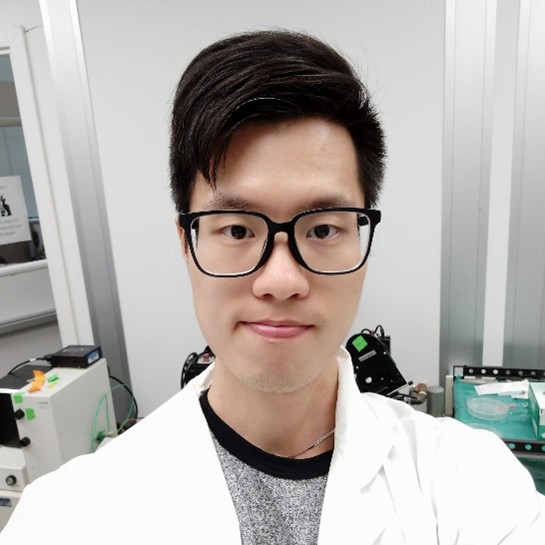
Principle Investigator: Sheng Yao(姚晟) Email:yaosheng@smu.edu.cn He is currently an Associate Professor with the School of Biomedical Engineering, Southern Medical University, Guangzhou, China. Before he joined Southern Medical University, he received the B.E. degree in Mechatronics Engineering and the Ph.D. degree in Mechanical Engineering from the South China University of Technology, Guangzhou, China, in 2016 and 2021, respectively. He was also a joint Ph.D. Student at the Department of Mechanical and Industrial Engineering, University of Toronto, Canada, from 2018 to 2019. His research interests include medical robotics and high-precision vision systems, with applications to cell surgery. 姚晟,南方医科大学生物医学工程学院副教授、硕士生导师,本科和博士均毕业于华南理工大学,2018至2019年曾在加拿大多伦多大学开展联合培养博士研究工作,于2021年加入南方医科大学生物医学工程学院工作至今,2023年起双聘于南方医院、珠江医院。 长期从事医学机器人感知与操控研究,致力于面向细胞手术的微操作机器人系统研发,并将其用于第三代试管婴儿技术的胚胎活检自动化。主持国自然青年项目、广东省自然科学基金项目、广州市科技计划面上项目、广东省医学科研基金等各级科研项目。 |
Co-Principle Investigator: Junjie Du(杜俊杰) Email:dujunjie@smu.edu.cn Junjie Du is a Lecturer with the School of Biomedical Engineering, Southern Medical University, Guangzhou, China. He was a postdoctoral researcher at The Chinese University of Hong Kong, and before that received the Ph.D. degree in Mechanical Engineering from the South China University of Technology, Guangzhou, China. His research interests include robotics for fracture rehabilitation. Robotics for fracture rehabilitation are designed to regulate the mechanical environment at the fracture site during bone healing. Our laboratory has developed adjustable-motion-direction compliant mechanisms that can control both the amplitude and direction of interfragmentary motion. By integrating rigid-body internal degrees of freedom with flexure elements, the translational motion direction can be continuously adjusted in three-dimensional space. A decoupled revolute–prismatic flexure joint was further developed to suppress undesired rotational deformation and maintain stable translational stiffness. These mechanisms provide a potential approach for delivering adaptable mechanical stimulation throughout different stages of fracture rehabilitation. 杜俊杰,南方医科大学生物医学工程学院讲师,香港中文大学博士后、华南理工大学博士。主要从事康复机器人的相关研究,工作聚焦于设计一类面向胫骨骨折康复的刚柔耦合并联机器人,以克服传统骨折康复机器人难进行主动康复训练的痛点。通过结合机器人机构学理论,并综合考虑机器人与胫骨骨折的耦合力学特性,重点研究如何设计并利用可变运动方向的刚柔耦合并联机构,实现对胫骨骨折端力学环境的合理调控,为促进骨折康复提供新工具。 |
|
Graduate Students: Yu Chen(陈雨) Jiaxi Wang(王嘉希) Guolin He(何果林) Zhonghao Chen(陈钟豪) Jiehua Li(李杰华) |
|
Undergraduate Research Interns: Zeyou Duan(段泽佑)2026 |